Pages

Showing posts with label evening. Show all posts

Wednesday, December 17, 2014

The Christmas of 1888


New York Times

December 18, 1888

Whittier's Birthday. Quietly Celebrated at his Farmhouse at Oak Knoll


Danvers, Mass., 

Dec. 17. -- At the quiet farmhouse at Oak Knoll, on the outskirts of the town of Danvers, there was a pleasant family circle to-day, and one of the most beloved of New-England's famous sons received congratulations on his eighty-first birthday. 
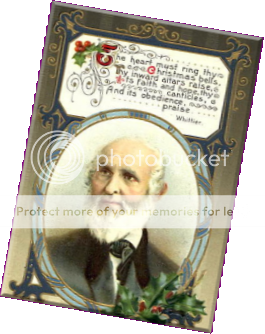
Here, surrounded with the tender care of the Misses Johnson and Mrs. Woodman the poet, John G. Whittier is quietly passing the Winter. Today being the anniversary of his birth The Time's representative called to pay his respects. 


The poet was found in his library, his erect figure and bright but kindly eye and the warm pressure of the hand gave but little token that more than fourscore years had passed over his head. A slight defect in hearing and snow-white hair and beard are the outward symbols of his ripe years. . . . 


Whittier would write of The Christmas of 1888 as follows . . .


Low in the east, against a white, cold dawn,
The black-lined silhouette of the woods was drawn,
And on a wintry waste
Of frosted streams and hillsides bare and brown,
Through thin cloud-films a pallid ghost looked down,
The waning moon half-faced.
In that pale sky and sere, snow-waiting earth,
What sign was there of the immortal birth?
What herald of the One?
Lo! swift as thought the heavenly radiance came,
A rose-red splendor swept the sky like flame,
Up rolled the round, bright sun!

And all was changed. From a transfigured world
The moon's ghost fled, the smoke of home-hearths curled
Up to the still air unblown.
In Orient warmth and brightness, did that morn
O'er Nain and Nazereth, when the Christ was born,
Break fairer than our own?

The morning's promise noon and eve fulfilled
In warm, soft sky and landscape hazy-filled
And sunset fair as they;
A sweet reminder of His holiest time,
A summer-miracle in our winter clime,
God gave a perfect day.

The near was blended with the old and far,
And Bethlehem's hillside and the Magi's star
Seemed here, as there and then, --
Our homestead pine-tree was the Syrian palm,
Our heart's desire the angels' midnight psalm,
Peace, and good-will to men!



See also ::


A little smile, a word of cheer,
A bit of love
from someone near,
A little gift from one held dear,
Best wishes for the coming year...
These make a Merry Christmas!

John Greenleaf Whittier
17 December 1807 ~ 07 September 1892


Monday, November 1, 2010

November twilights just begun


As the afternoons grow shorter, and the early evening drives us home to complete our chores, we are reminded of the shortness of life, and become more pensive, at least in the twilight of the year. We are prompted to make haste and finish our work before the night comes. I leaned over a rail in the twilight on the Walden road, waited for the evening mail to be distributed, when such thoughts visited me. I seemed to recognize the November evening as a familiar thing come round again, and yet I could hardly tell whether I had ever known it or only divined it. The November twilight's just begun! . . . Thoreau's Journal . . . 1st November 1858 . . .


Sunday, October 10, 2010

The Barefoot Boy


In memory of my Dad . . .


Blessings on thee, little man,

Barefoot boy, with cheek of tan!

With thy turned-up pantaloons,

And thy merry whistled tunes;

With thy red lip, redder still

Kissed by strawberries on the hill;

With the sunshine on thy face,

Through thy torn brim's jaunty grace;

From my heart I give thee joy,

I was once a barefoot boy!

Prince thou art, - the grown-up man

Only is republican.

Let the million-dollared ride!

Barefoot, trudging at his side,

Thou hast more than he can buy

In the reach of ear and eye,

Outward sunshine, inward joy:

Blessings on thee, barefoot boy!


Oh for boyhood's painless play,

Sleep that wakes in laughing day,

Health that mocks the doctor's rules,

Knowledge never learned of schools,

Of the wild bee's morning chase,

Of the wild-flower's time and place,

Flight of fowl and habitude

Of the tenants of the wood;

How the tortoise bears his shell,

How the woodchuck digs his cell,

And the ground-mole sinks his well;

How the robin feeds her young,

How the oriole's nest is hung;

Where the whitest lilies blow,

Where the freshest berries grow,

Where the ground-nut trails its vine,

Where the wood-grape's clusters shine;

Of the black wasp's cunning way,

Mason of his walls of clay,

And the architectural plans

Of gray hornet artisans!

For, eschewing books and tasks,

Nature answers all he asks;

Hand in hand with her he walks,

Face to face with her he talks,

Part and parcel of her joy,

Blessings on the barefoot boy!


Oh for boyhood's time of June,

Crowding years in one brief moon,

When all things I heard or saw,

Me, their master, waited for.

I was rich in flowers and trees,

Humming-birds and honey-bees;

For my sport the squirrel played,

Plied the snouted mole his spade;

For my taste the blackberry cone

Purpled over hedge and stone;

Laughed the brook for my delight

Through the day and through the night,

Whispering at the garden wall,

Talked with me from fall to fall;

Mine the sand-rimmed pickerel pond,

Mine the walnut slopes beyond,

Mine, on bending orchard trees,

Apples of Hesperides!

Still as my horizon grew,

Larger grew my riches too;

All the world I saw or knew

Seemed a complex Chinese toy,

Fashioned for a barefoot boy!


Oh for festal dainties spread,

Like my bowl of milk and bread;

Pewter spoon and bowl of wood,

On the door-stone, gray and rude!

O'er me, like a regal tent,

Cloudy-ribbed, the sunset bent,

Purple-curtained, fringed with gold,

Looped in many a wind-swung fold;

While for music came the play

Of the pied frogs' orchestra;

And, to light the noisy choir,

Lit the fly his lamp of fire.

I was monarch: pomp and joy

Waited on the barefoot boy!


Cheerily, then, my little man,

Live and laugh, as boyhood can!

Though the flinty slopes be hard,

Stubble-speared the new-mown sward,

Every morn shall lead thee through

Fresh baptisms of the dew;

Every evening from thy feet

Shall the cool wind kiss the heat:

All too soon these feet must hide

In the prison cells of pride,

Lose the freedom of the sod,

Like a colt's for work be shod,

Made to tread the mills of toil,

Up and down in ceaseless moil:

Happy if their track be found

Never on forbidden ground;

Happy if they sink not in

Quick and treacherous sands of sin.

Ah! that thou couldst know thy joy,

Ere it passes, barefoot boy!


John Greenleaf Whittier


Tuesday, June 9, 2009

Do not stand at my grave and weep . . .


Gentle Autumn's Rain

Do not stand at my grave and weep
I am not there, I do not sleep
I am a thousand winds that blow
I am the diamond glint on snow
I am the sunlight on ripened grain
I am the gentle autumn rain

When you wake in the morning hush
I am the swift, uplifting rush
Of quiet birds in circling flight
I am the soft starlight at night
I am the song that will never end
I am the love of family and friend

I am the child who has come to rest
In the arms of the Father  who knows him best
When you see the sunset fair
I am the scented evening air
I am the joy of a task well done
I am the glow of the setting sun

Do not stand at my grave and cry
I am not there, I did not die

Original verse by Mary Frye (1932)
Additional verse by Wilbur Skeels (1996)

Monday, March 30, 2009

The Shades of Evening


". . . Thus was his fair dawn of life, whilst his cloudless sun was nearing its meridian, in a moment veiled in the shades of death. . . . As the stars of heaven shine brighter at the close of day when the shades of evening gather over the earth, even so do his virtues beam with brighter lustre from the darkness of the silent tomb: and long shall it be ere there shall cease to be found in memory's waste, a green spot watered by the tears of affection for him who is gone."

Centennial History of Harrison, Maine: Containing the Centennial Celebration of 1905, and Historical and Biographical Matter :: By Alphonso Moulton, Howard L. Sampson, Granville Fernald :: Published by the authority of the town, 1909 :: Original from Harvard University :: Digitized Aug 21, 2006 :: 727 pages