On Thanksgiving day
the memory becomes
a kaleidoscope,
and every minute
the scene changes.
You give
to the kaleidoscope of memory
a turn
and there they are,
natural as life,
around the country hearth
on a cold winter night.
I see that old Thanksgiving dinner.
Father at one end,
mother at the other end,
the children between . . .
Of the ten at that table,
all are gone save two --
some in village churchyard,
some in city cemetery --
but we shall sit with them yet
at a brighter banquet.
Rev. T. De Witt Talmage. (1832-1902)
Rockdale Reporter. (Rockdale, Tex.), Vol. 10, No. 42, Ed. 1 Thursday, November 19, 1903 Page: 8 of 10
New York Times
December 18, 1888
Whittier's Birthday. Quietly Celebrated at his Farmhouse at Oak Knoll.
Danvers, Mass.,
Dec. 17. -- At the quiet farmhouse at Oak Knoll, on the outskirts of the town of Danvers, there was a pleasant family circle to-day, and one of the most beloved of New-England's famous sons received congratulations on his eighty-first birthday.
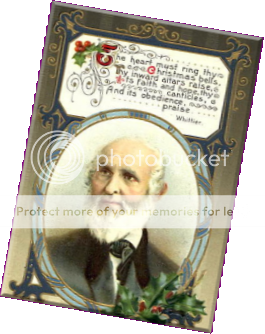
Here, surrounded with the tender care of the Misses Johnson and Mrs. Woodman the poet, John G. Whittier is quietly passing the Winter. Today being the anniversary of his birth The Time's representative called to pay his respects.
The poet was found in his library, his erect figure and bright but kindly eye and the warm pressure of the hand gave but little token that more than fourscore years had passed over his head. A slight defect in hearing and snow-white hair and beard are the outward symbols of his ripe years. . . .
Whittier would write of The Christmas of 1888 as follows . . .
Low in the east, against a white, cold dawn,
The black-lined silhouette of the woods was drawn,
And on a wintry waste
Of frosted streams and hillsides bare and brown,
Through thin cloud-films a pallid ghost looked down,
The waning moon half-faced.
In that pale sky and sere, snow-waiting earth,
What sign was there of the immortal birth?
What herald of the One?
Lo! swift as thought the heavenly radiance came,
A rose-red splendor swept the sky like flame,
Up rolled the round, bright sun!
And all was changed. From a transfigured world
The moon's ghost fled, the smoke of home-hearths curled
Up to the still air unblown.
In Orient warmth and brightness, did that morn
O'er Nain and Nazereth, when the Christ was born,
Break fairer than our own?
The morning's promise noon and eve fulfilled
In warm, soft sky and landscape hazy-filled
And sunset fair as they;
A sweet reminder of His holiest time,
A summer-miracle in our winter clime,
God gave a perfect day.
The near was blended with the old and far,
And Bethlehem's hillside and the Magi's star
Seemed here, as there and then, --
Our homestead pine-tree was the Syrian palm,
Our heart's desire the angels' midnight psalm,
Peace, and good-will to men!

See also ::
A little smile, a word of cheer,
A bit of love
from someone near,
A little gift from one held dear,
Best wishes for the coming year...
These make a Merry Christmas!
John Greenleaf Whittier
17 December 1807 ~ 07 September 1892
![]()
It was the best of times, it was the worst of times, it was the age of wisdom, it was the age of foolishness, it was the epoch of belief, it was the epoch of incredulity, it was the season of Light, it was the season of Darkness, it was the spring of hope, it was the winter of despair, we had everything before us, we had nothing before us, we were all going direct to heaven, we were all going direct the other way - in short, the period was so far like the present period, that some of its noisiest authorities insisted on its being received, for good or for evil, in the superlative degree of comparison only.
from
A Tale of Two Cities
by
Charles Dickens
07 February 1812 – 09 June 1870
Farewell, Old Year, we walk no more together,
I catch the sweetness of thy latest sigh;
And, crowned with yellow brake and withered heather,
I see thee stand beneath this cloudy sky.
Here, in the dim light of a gray December,
We part in smiles, and yet we met in tears,
Watching thy chilly dawn, I well remember
I thought thee saddest born of all the years.
I knew not then what precious gifts were hidden
Under the mists that veiled thy path from sight;
I knew not then that joy would come unbidden
To make thy closing hours divinely bright.
I only saw the dreary clouds unbroken,
I only heard the plash of icy rain;
And in that winter gloom, I found no token
To tell me that the sun would shine again.
O dear Old Year, I wronged a Father's kindness;
I would not trust Him with my load of care,
I stumbled on in weariness and blindness,
And lo! He blessed me with an answered prayer.
Good-bye, kind Year! We walk no more together,
But here in quiet happiness we part;
And, from thy wreath of faded fern and heather,
I take some sprays and wear them on my heart.
by
Sarah Doudney (1841-1926)
found in
1882 The Living Age
The lamp is burning low upon my table top
The snow is softly falling
The air is still in the silence of my room
I hear your voice softly calling.
If I could only have you near
To breathe a sigh or two
I would be happy just to hold the hands I love
On this winter night with you. . . .
The fire is dying now, my lamp is growing dim
The shades of night are lifting
The morning light steals across my windowpane
Where webs of snow are drifting.
If I could only have you near, to breathe a sigh or two
I would be happy just to hold the hands I love
And to once again be with you
On this winter night with you.
Gordon Lightfoot


